
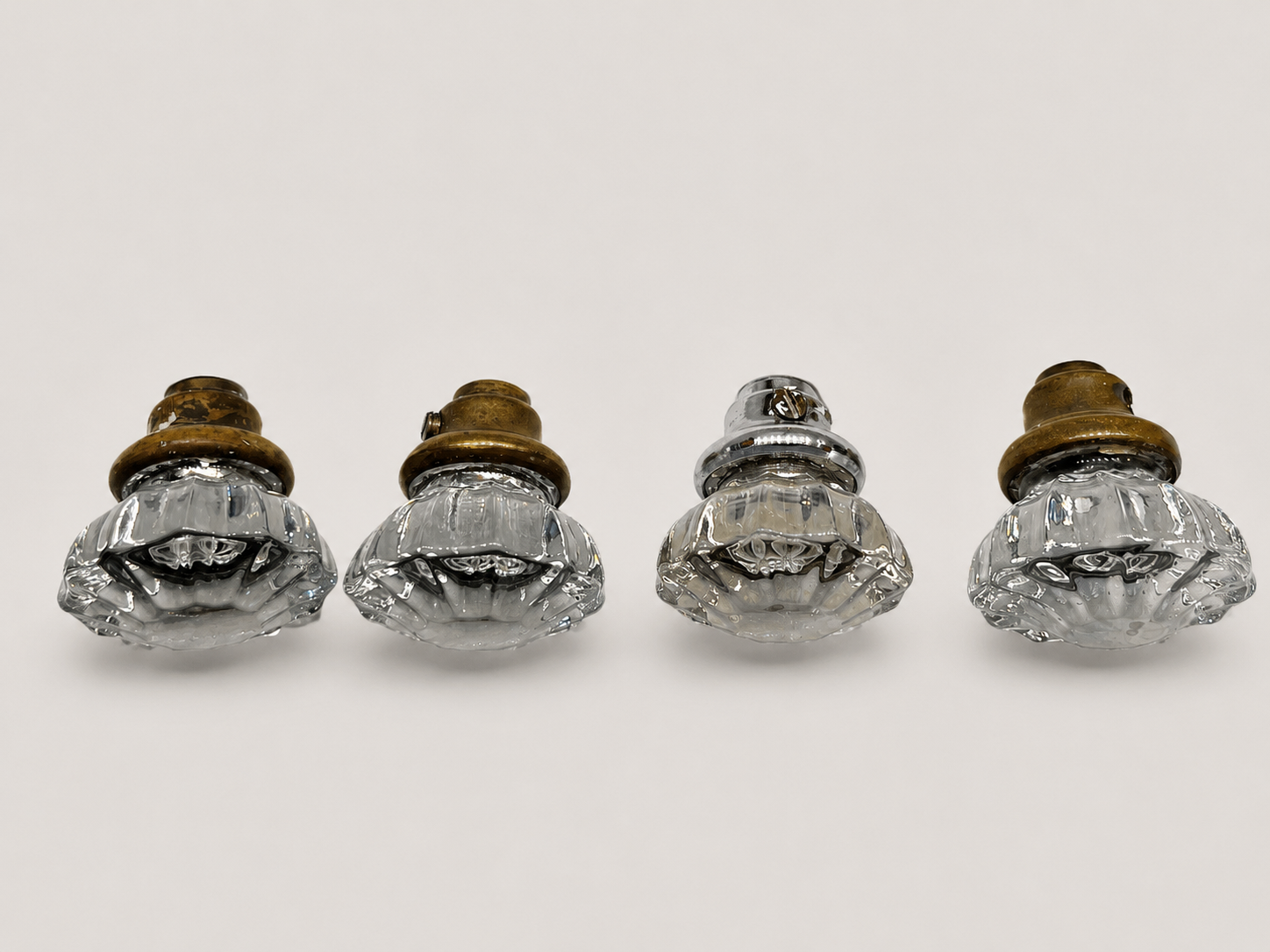
You find a beautiful old door in your home with its original hardware still intact, except for one missing glass knob. If you need to replace a vintage door knob without replacing the rest of the original hardware, finding the right match can be easier than you might think.
Or perhaps you discover a wonderful vintage glass door knob at an estate sale or antique shop, only to realize it’s just one knob, not a complete set.
Don’t pass it by just yet.
One of the wonderful things about vintage architectural hardware is that many of its individual components can be replaced, matched, or adapted. A single antique glass knob may be exactly what someone else needs to complete an original door, and an orphaned knob can often be paired with readily available hardware to put it back into use.
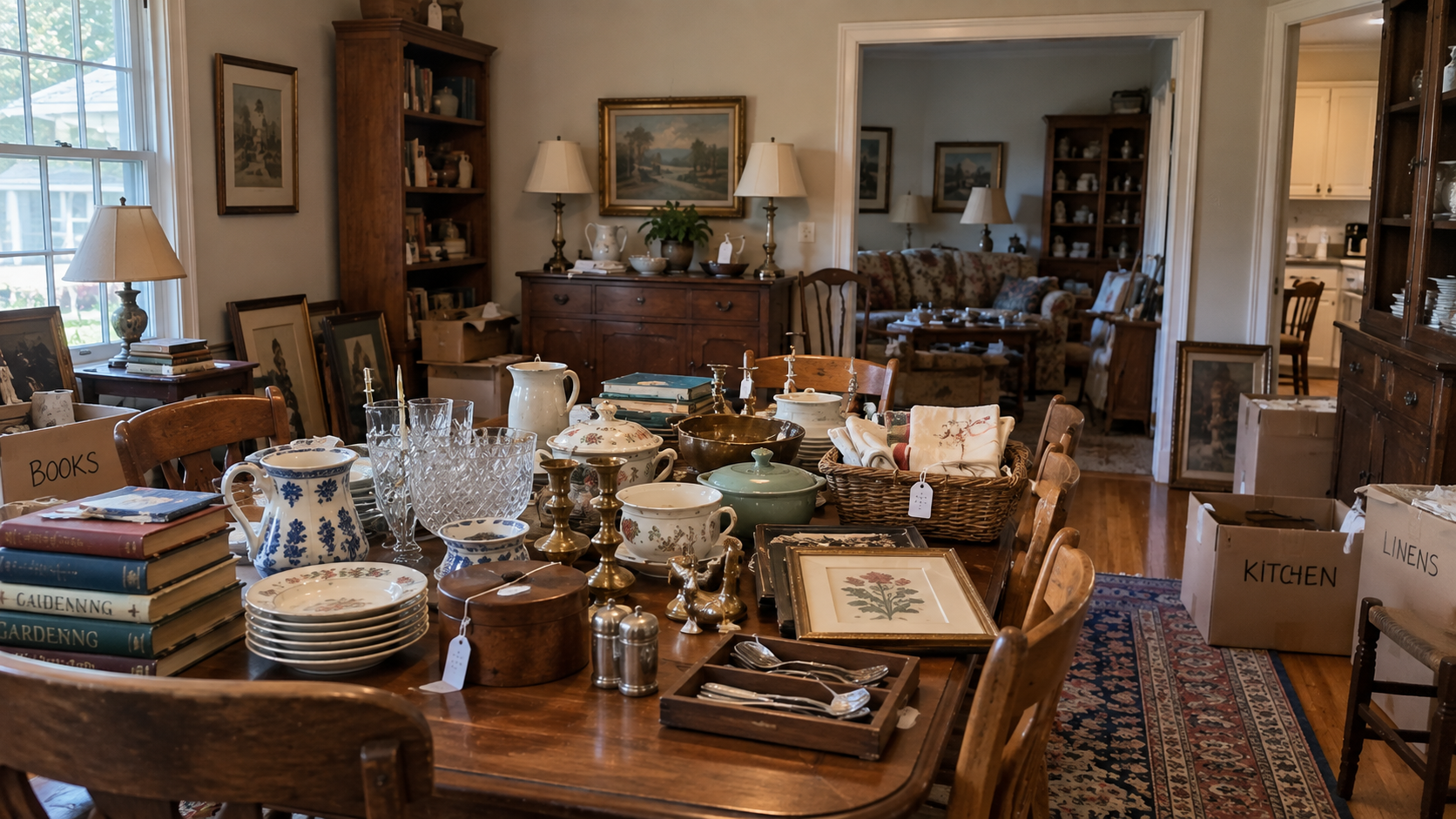
At Parker Place Antiques, we love finding these individual pieces of architectural history at estate sales and giving them the opportunity to be useful again.
Here’s what to know before you start.
First: You May Not Need a Matching Pair
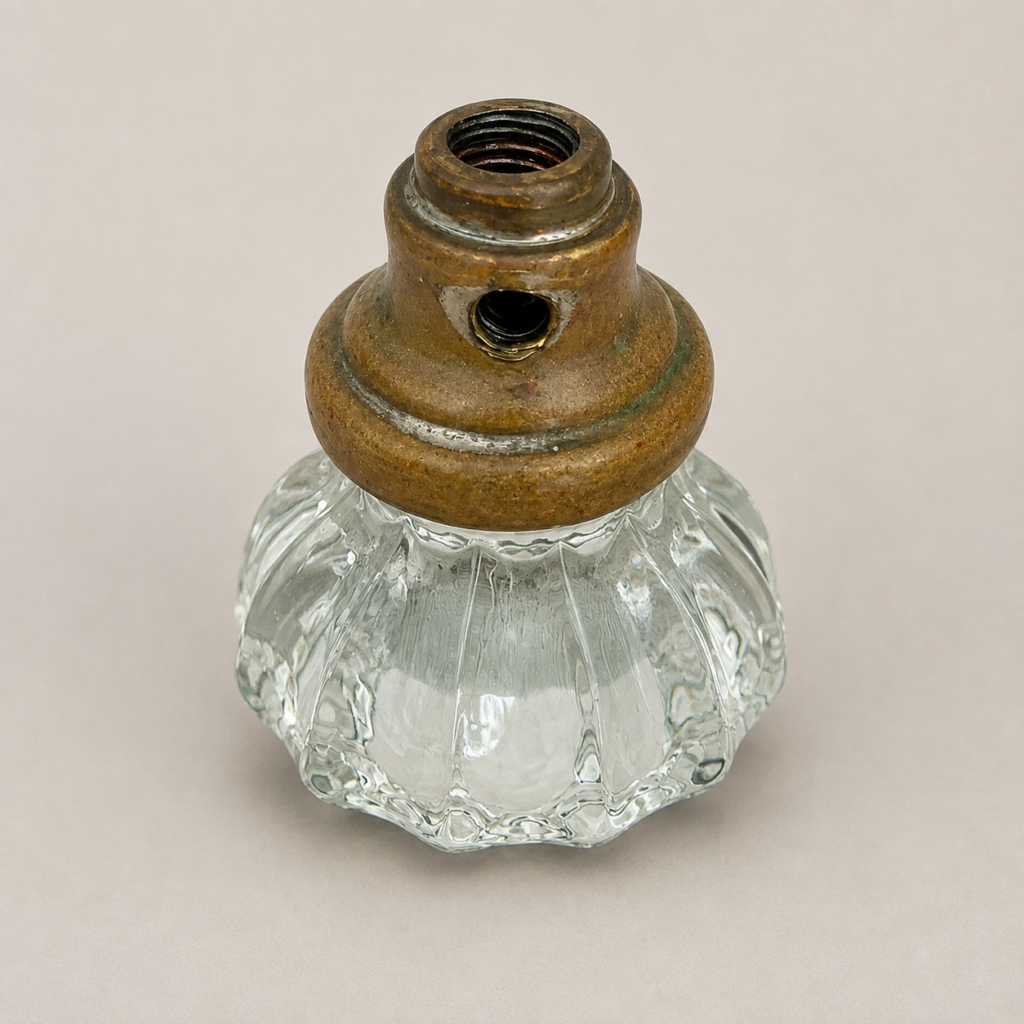
Many older door knob assemblies were designed around a metal spindle that passes through the door and connects the knob on each side.
That means a missing knob doesn’t necessarily require replacing the knob on the other side, or replacing all of the original hardware.
If the existing spindle, latch, rosette, and opposite knob are still usable, you may simply need to find a compatible replacement knob.
The replacement doesn’t always have to be an identical match, either. In an older home where hardware has evolved over generations, a slightly different glass pattern or metal finish can look perfectly at home.
The key is determining how the knob attaches and whether its dimensions are compatible with your existing hardware.
What Hardware Does a Vintage Glass Door Knob Need?
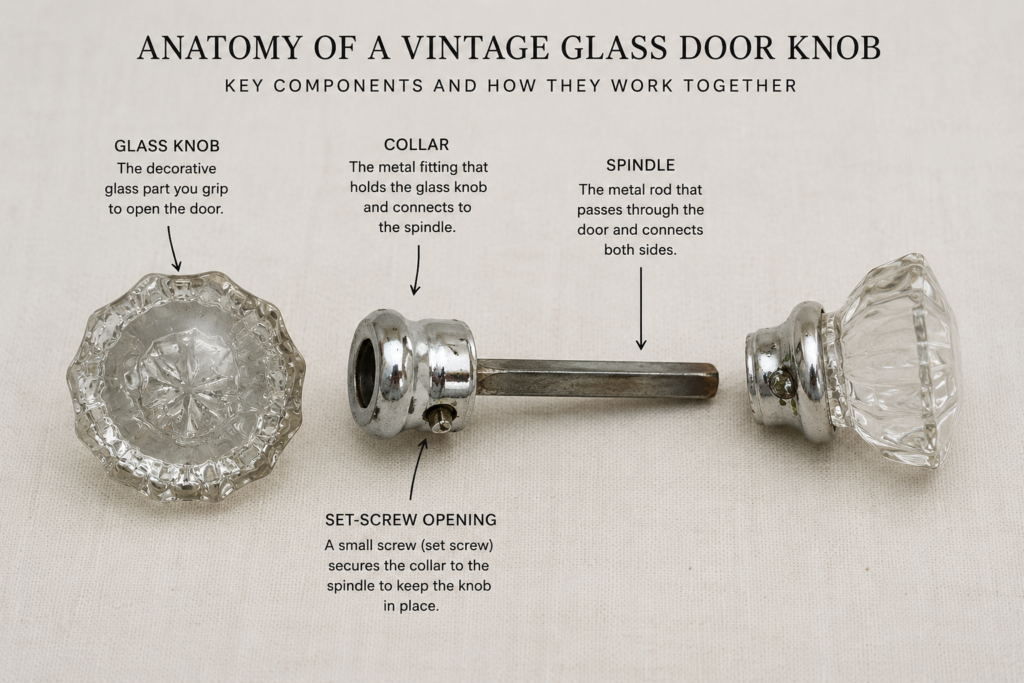
A glass knob is only one part of the complete door hardware assembly. Depending on what remains on your door, you may need some, or all, of the following pieces.
1. Spindle
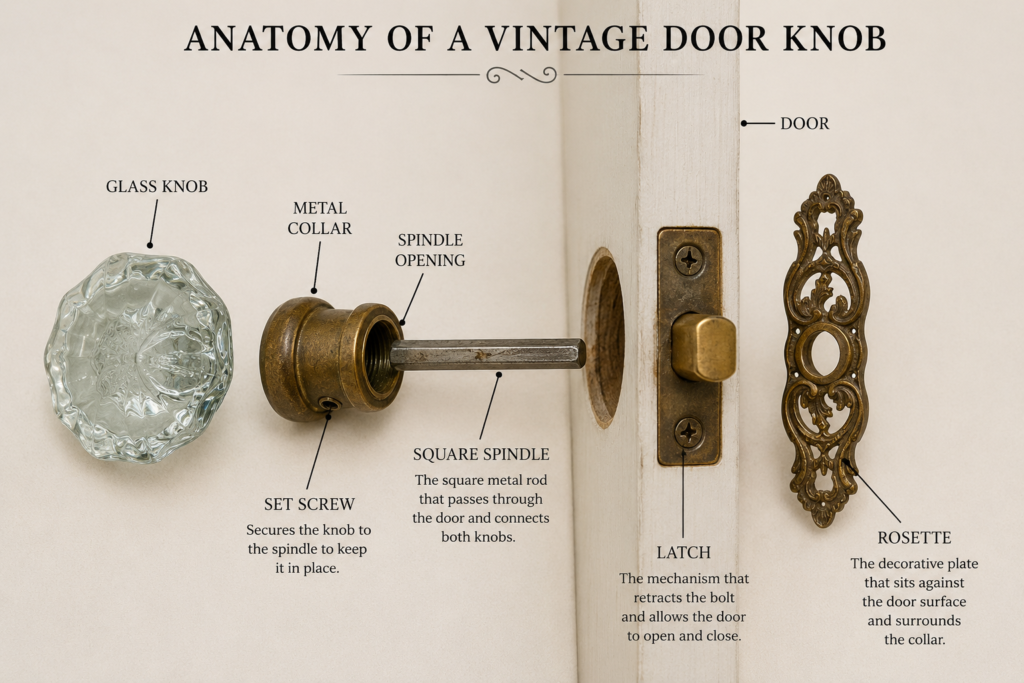
The spindle is the metal rod that passes through the door and connects the knobs on either side.
Many vintage door knobs use a square spindle, but the way the knobs attach to that spindle can vary.
Some knobs thread directly onto a threaded spindle. Others slide onto the spindle and are secured with a small set screw.
If you’re purchasing a single replacement knob, examine the opening in the metal collar carefully and compare it with your existing spindle before assuming the two will work together.
Replacement and reproduction spindles are available, so finding an antique knob without its original spindle doesn’t necessarily make the knob unusable.
2. Set Screw
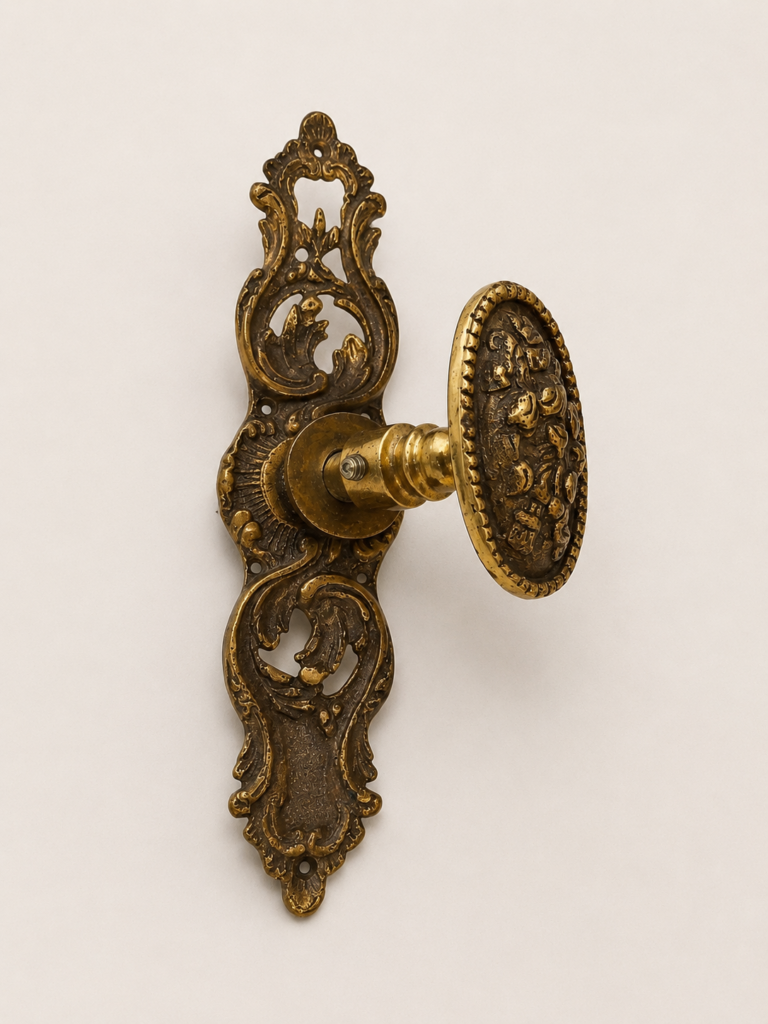
That tiny screw on the side of an old door knob collar has an important job: it helps secure the knob to the spindle.
Set screws are frequently missing from salvaged hardware.
If the knob you’re considering has a set-screw opening but no screw, don’t automatically reject it. Replacement screws can often be sourced. What matters is finding the correct thread size and ensuring the screw works with the knob and spindle.
3. Rosette
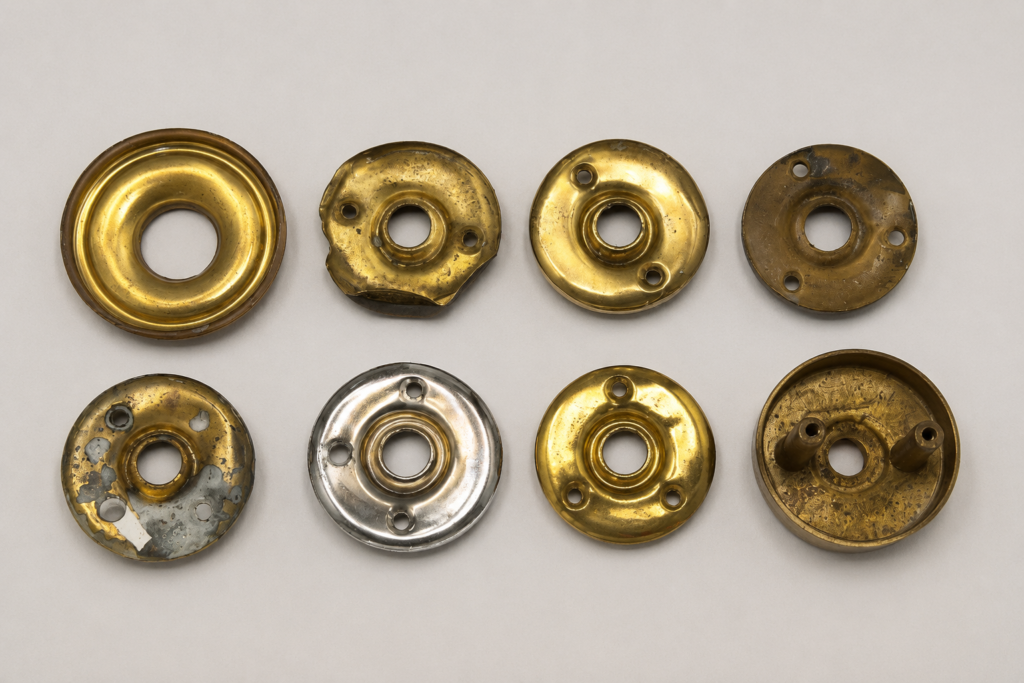
The decorative plate surrounding the base of the knob is generally called a rosette.
Rosettes protect the door surface while giving the hardware a finished appearance. They were produced in everything from simple round brass designs to highly decorative Victorian and Art Deco patterns.
If your original rosette remains on the door, you may be able to reuse it with your replacement knob.
If it’s missing, vintage and reproduction rosettes are both available.
4. Latch or Lock Mechanism
Inside the door is the mechanism that actually allows the door to latch.
Before assuming a missing or loose knob is the entire problem, check whether the existing latch mechanism still functions properly.
An original glass knob can sometimes be used with replacement internal hardware, allowing you to preserve the visible vintage character while replacing the worn mechanical component.
For complicated repairs—or whenever you’re unsure whether old and new components are compatible, an experienced locksmith or historic-hardware specialist can be well worth consulting.
5. Strike Plate
The strike plate is mounted to the door frame and receives the latch when the door closes.
If the existing strike plate still lines up and functions properly, there’s usually no reason to replace it simply because you’re replacing a knob.
6. Keyhole Escutcheon
On doors originally fitted with locks, you may also see a small decorative plate surrounding the keyhole.
These are called escutcheons or keyhole covers and can be wonderfully decorative pieces of hardware in their own right.
They aren’t necessary for the knob itself to function, but preserving an original escutcheon can help maintain the historic character of the door.
What Should You Measure Before Buying a Replacement Knob?
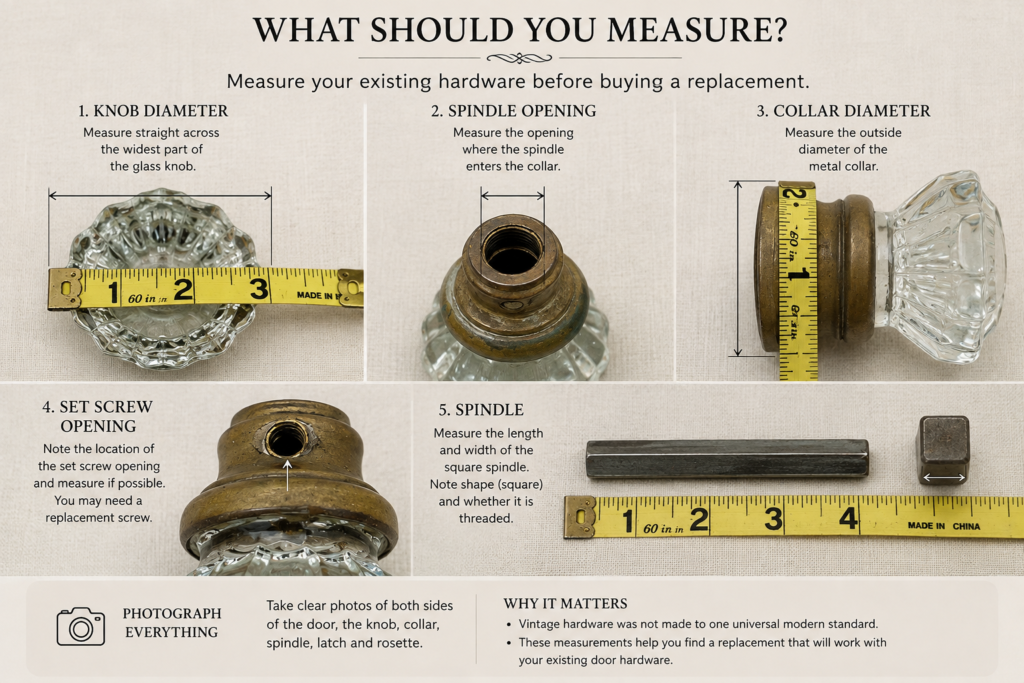
This is the step we’d never skip. When you’re trying to replace a vintage door knob, a few measurements and close-up photos can make the search much easier.
Vintage hardware was not manufactured to one universal modern standard, and a knob that looks perfect in a photograph may not work with your existing hardware.
Before shopping, take several measurements and photographs.
Measure the knob diameter. Vintage glass knobs come in different sizes, and even a difference of a quarter inch can be noticeable when you’re trying to match an existing knob.
Measure the spindle. Note its width, length, shape, and whether it is threaded.
Examine the knob opening. Photograph the opening where the spindle enters the knob, including any threads or set-screw holes.
Measure the rosette. If you’re keeping the existing rosette, record its outside diameter and the size of its center opening.
Photograph everything before disassembly. Take pictures of both sides of the door, the knob profile, collar, spindle, rosette, and latch. Those photographs can be invaluable when comparing replacement pieces later.
And if you’re shopping online, don’t be afraid to ask the seller for an additional measurement. With vintage hardware, an extra eighth of an inch can matter.
Glass, Crystal or Pressed Glass?
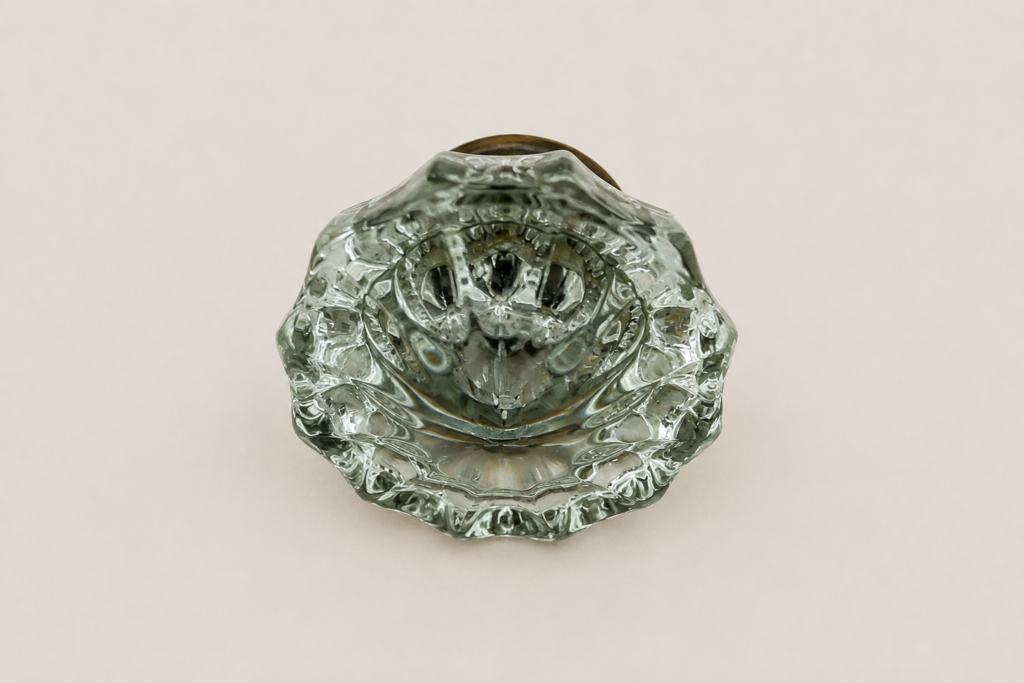
Not every clear vintage knob is technically crystal.
Many of the beautiful faceted knobs found in American homes during the early twentieth century were made from pressed or molded glass. Others were cut glass, and manufacturers produced countless patterns over the decades.
For a homeowner trying to preserve the character of an older door, matching the overall appearance, size and construction is usually more important than finding an absolutely identical glass pattern.
Clear faceted glass also pairs beautifully with several different metal finishes, which brings us to another common question.
Does the Metal Collar Have to Match?
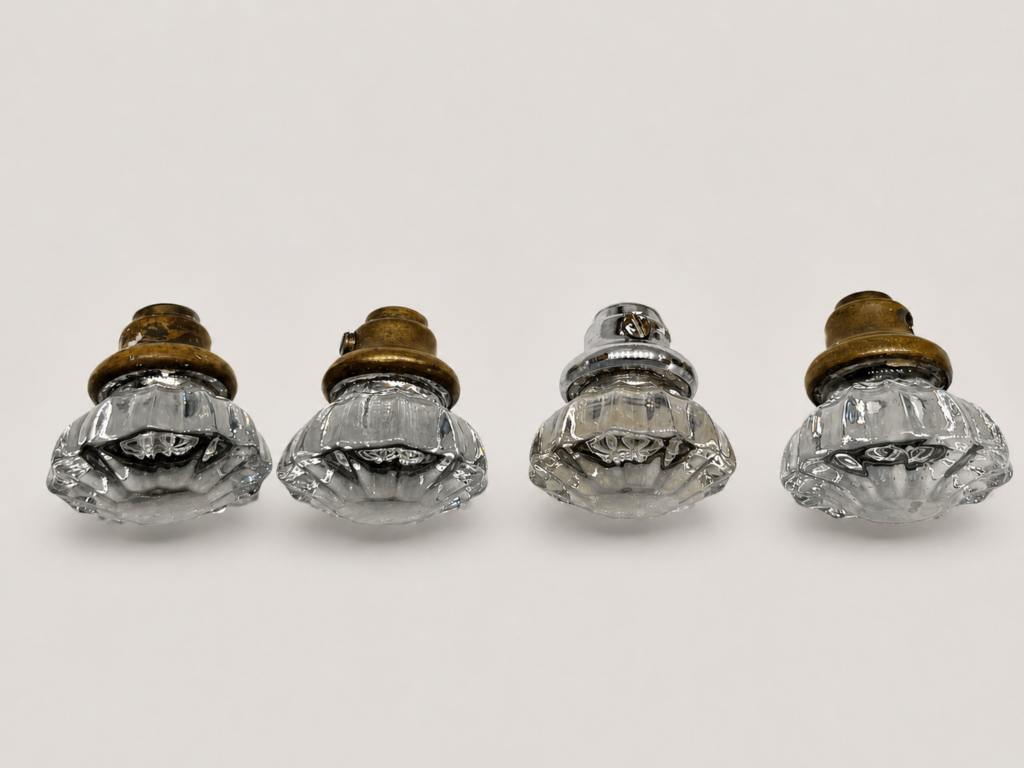
Not necessarily.
Vintage glass knobs can be found with brass, nickel, chrome and other metal collars and fittings.
If you’re restoring an especially significant historic interior, matching the original finish may be important. But in many older homes, hardware already reflects decades of repairs and changes.
A glass knob with an aged brass collar can look perfectly natural alongside other warm-toned hardware, while nickel or chrome can work beautifully in homes with early twentieth-century or Art Deco details.
The goal doesn’t always have to be perfect uniformity.
Sometimes the goal is simply to make the replacement look as though it belongs to the house.
Can You Use Reproduction Hardware with an Antique Knob?
Yes, and sometimes that’s the most practical solution.
An authentic vintage knob can remain the visible focal point while a reproduction spindle, set screw, rosette, or other component handles the functional work behind it.
For us, that’s far preferable to discarding a beautiful original piece simply because one small component disappeared somewhere during the last 75 or 100 years.
Just remember that “reproduction” does not automatically mean “universal.” Check dimensions and compatibility before ordering.
Common Mistakes When Buying a Single Vintage Door Knob
The biggest mistake is buying solely because a knob looks like the right one.
Before purchasing, avoid these common pitfalls:
- Assuming all square spindles are interchangeable
- Forgetting to check whether the knob is threaded
- Overlooking a missing set screw
- Failing to measure the knob diameter
- Assuming every brass or chrome collar is the same size
- Buying a knob without examining the spindle opening
- Throwing away original rosettes or escutcheons before determining whether they can be reused
- Replacing an entire original hardware set when only one component actually needs attention
Why We Save the Orphans
Looking for a Vintage Replacement?
Parker Place Antiques regularly sources vintage and antique architectural hardware, including individual glass door knobs, cabinet and drawer hardware, backplates, locks, pulls, and other unusual salvage pieces.
Because our inventory comes primarily from estates and individual collections, what’s available is always changing.
Browse our current vintage architectural hardware collection in the Parker Place Antiques Etsy shop.
And before ordering a replacement piece, compare the listing measurements carefully with your existing hardware. If you need a measurement that isn’t shown, ask, we’d much rather help you determine whether a piece might work before it makes the trip to its next home.
Sometimes one old knob really is all you need!